
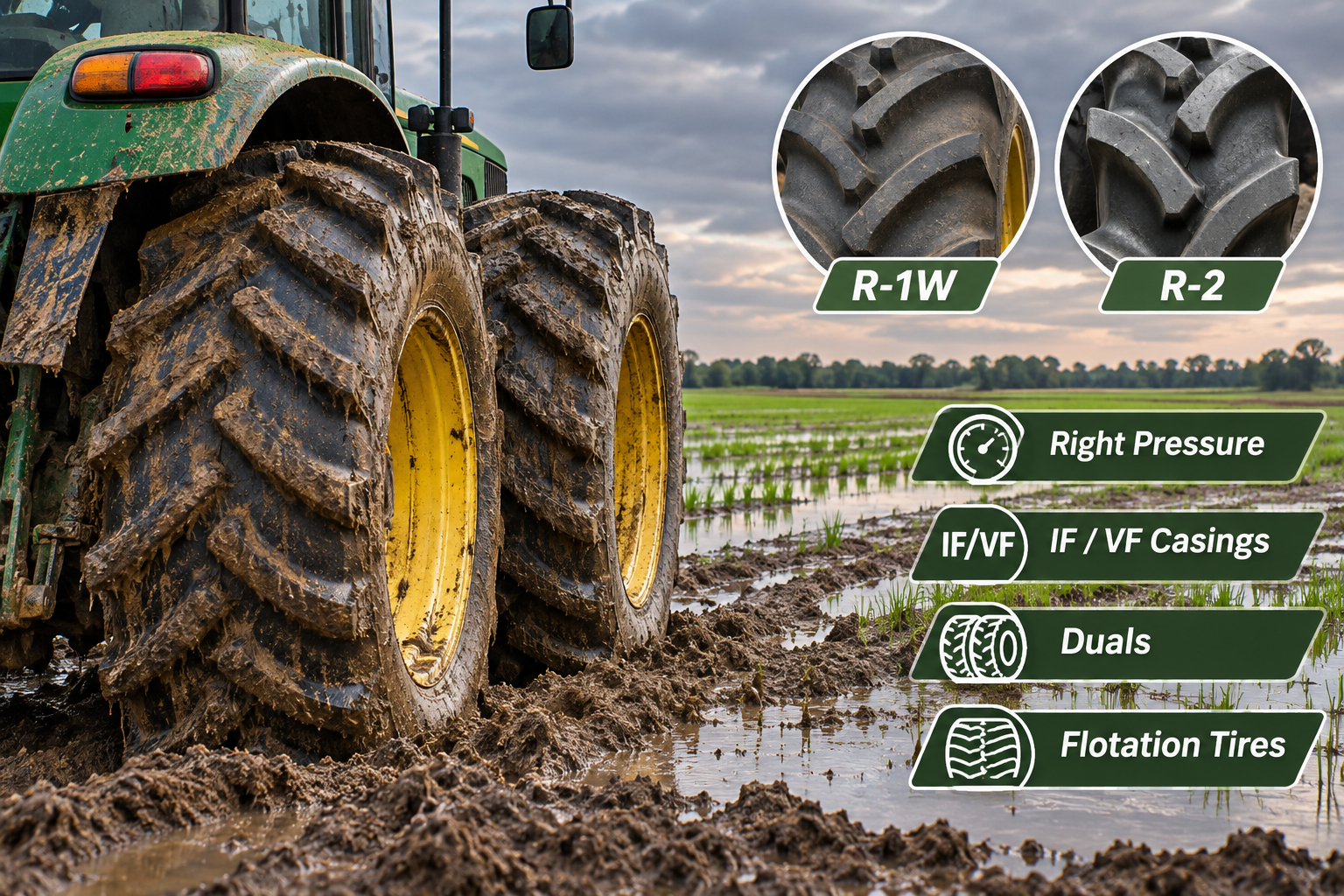
The right tractor tire for wet fields depends on which problem the water is causing. If the tires spin, you need traction: an R-1W tread for soft ground most seasons, or an R-2 for rice, cane, and fields that stay saturated. If the tires sink and cut ruts, you need footprint: lower pressure, IF or VF casings, duals, or flotation sizes. Many wet-ground problems are the second kind wearing the first kind’s costume.
Everything on this page applies to full-size agricultural equipment: row-crop and high-horsepower tractors, combines, grain carts, and sprayers. That is what Bobby Henard Tire stocks and ships nationwide.
First question: are you spinning or sinking?
Watch what the tire actually does when the field gets wet.
Spinning means the lugs are packing full of mud and losing their biting edge. The tractor has support under it but cannot pull. That is a tread problem, and deeper, wider-spaced lugs fix it.
Sinking means the ground will not carry the machine’s weight. The tire cuts in, the tractor pulls hard just to move itself, and the field keeps the ruts until tillage. That is a footprint problem, and no amount of tread depth fixes it. A deeper lug on the same narrow, hard-inflated tire just digs a neater trench.
Most operations that farm wet ground eventually need an answer to both. Here is each one in turn.
Fixing a traction problem: tread depth and spacing
Agricultural drive treads come in three depths, and the wet-ground ladder runs straight up through them. R-1 is the standard tread and handles normal moisture. R-1W cuts the same lug design about 20 to 25 percent deeper and keeps biting in soft, damp ground after a standard lug has packed full; for most row-crop operations with wet springs, it is the answer. R-2 doubles R-1’s depth with wide-spaced, self-cleaning lugs and is built for flooded and saturated ground: rice, cane, and levee work. Our side-by-side guide to R-1 vs R-1W vs R-2 covers the wear, ride, and price trade-offs in detail.
The short version of the trade-off: depth that cleans itself in the mud rides rough and wears fast on the road. Buy as much tread as your wet days require and no more. A tractor that fights mud two weeks a year does not need an R-2; a rice tractor does.
Fixing a flotation problem: put more footprint on the ground
When the ground will not support the machine, the goal is to spread its weight over more square inches. Four tools do that, in roughly the order to try them:
Run the right pressure. Most tractors on soft ground are overinflated for the job. Dropping to the tire maker’s minimum pressure for the actual axle load lengthens the footprint and is free. The inflation tables, not habit, set the number.
Step up to IF or VF casings. IF (Increased Flexion) and VF (Very High Flexion) tires are engineered to run meaningfully lower pressures at the same load, VF roughly 40 percent lower than a standard radial. On wet ground, that turns directly into a longer, wider footprint and less rutting. Our IF vs VF guide covers the ratings and when the premium pays.
Add duals. Doubling the tires on an axle roughly doubles the rubber carrying it, without changing row spacing. Duals are the standard wet-ground answer on row-crop and high-horsepower tractors, and they pair with any tread depth.
Go to flotation sizes. For grain carts, spreaders, and sprayers that carry weight rather than pull, wide high-volume flotation tires at low pressure keep the load on top of soft ground. They give up narrow-row clearance, which is why they live on implements more than on row-crop drive axles.
In practice, the strongest wet-field setup on a drive axle is usually an R-1W or R-2 tread on a VF casing, run at the low pressure the casing allows, with duals where the rows permit.
The honest part: some ground is just not ready
No tire makes saturated soil carry a 20-ton tractor. If the machine sinks at the field edge, the choice that protects yield is waiting, and the compaction from forcing it shows up in the crop for years. The right tire setup widens the window of workable days at the margins. It does not repeal soil physics, and anyone who tells you otherwise is selling something other than tires.
Wet ground is home ground for us
Bobby Henard Tire has been fitting tires for Delta agriculture since 1965, and the Arkansas, Mississippi, and Louisiana rice and row-crop country around us is some of the wettest working ground in America. Fall harvests that turn to mud, flooded rice fields, gumbo that grabs a standard lug and will not let go: this is the exact problem set the company grew up on, and it is why the answers above are field answers, not catalog answers.
Wet field tire questions
What is the best tractor tire for mud? For ground that is soft and muddy part of the season, an R-1W. For rice, cane, and fields that stay saturated, an R-2, whose deep, wide-spaced lugs self-clean in the mud. If the tractor is sinking rather than spinning, address footprint (pressure, IF/VF, duals) before tread depth.
Do wider tires or duals work better in wet fields? Duals, in most row-crop situations. They add footprint without changing row-spacing clearance, and they let you keep a tread suited to your ground. Single wide or flotation tires win on implements and in operations without row constraints.
Can I just air down my current tires for wet ground? Down to the manufacturer’s minimum pressure for your actual load, yes, and it helps more than most people expect. Below that number, no: underinflating past the table damages the casing. If the table’s minimum is not enough footprint, that is what IF and VF tires are for.
Do you carry wet-ground tires for compact or Kubota tractors? No. We stock tires for full-size agricultural equipment only: row-crop and high-horsepower tractors, combines, sprayers, and ag implements. We do not carry compact, utility, lawn, or Kubota/sub-compact tractor tires.
Get a wet-ground setup that works
Every tread and casing on this page is in stock in the sizes full-size ag equipment actually runs, with freight shipping anywhere in the country. Browse our tractor tire selection, or call the team with your tractor model, your ground, and your wettest month, and get a recommendation from people who have pulled a few thousand tractors’ worth of tires through Delta mud.