
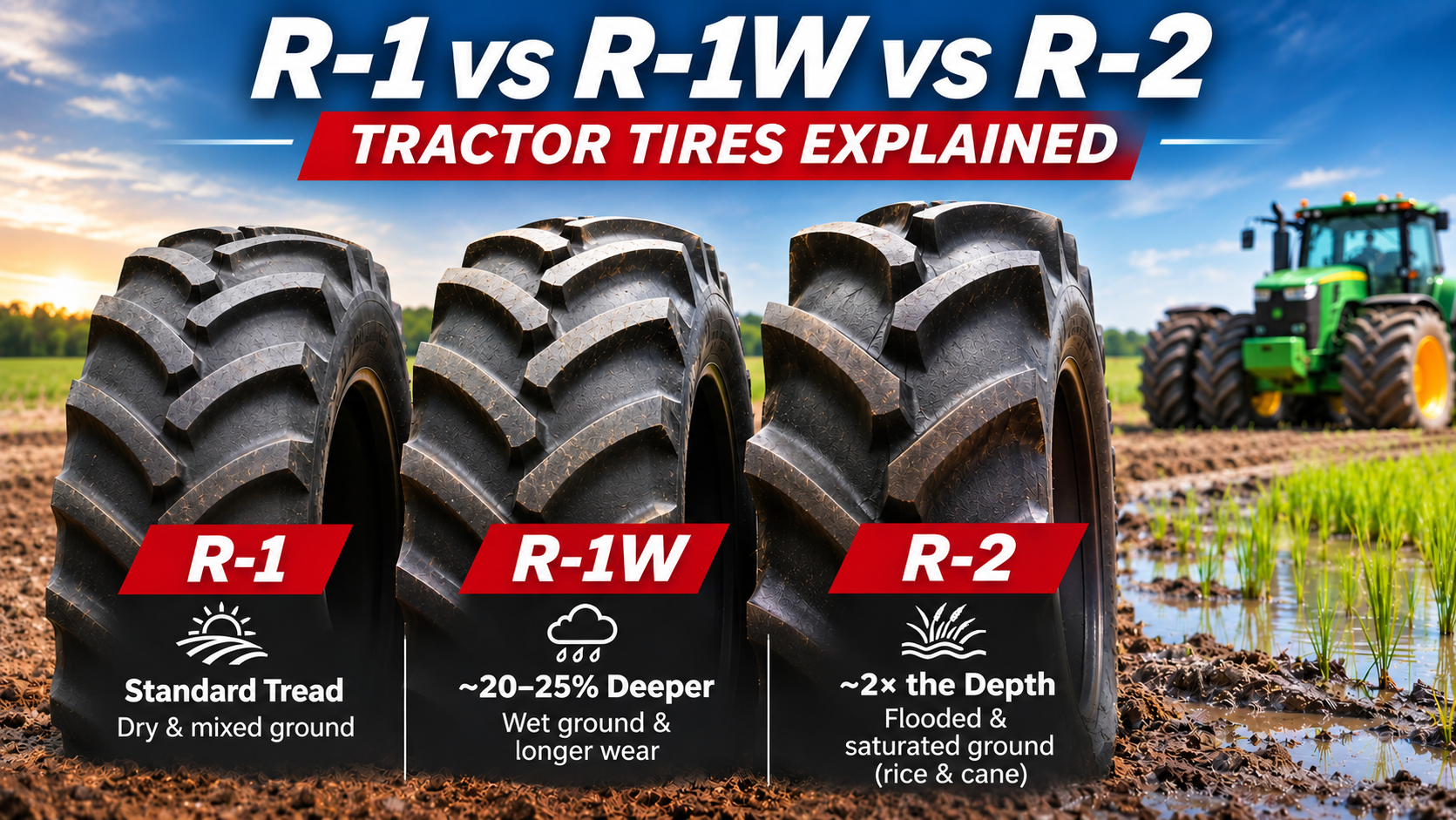
R-1, R-1W, and R-2 are the three tread depths for agricultural drive tires. R-1 is the standard tread for dry and mixed field conditions. R-1W runs about 20 to 25 percent deeper for wet ground and longer wear. R-2 runs roughly twice the depth of R-1 and is built for rice, cane, and fields that stay saturated. Most row-crop operations land on R-1 or R-1W; R-2 is a specialty tool.
All three codes describe tires for full-size agricultural equipment: row-crop tractors, high-horsepower and articulated 4WD machines, and the implements behind them. That is what Bobby Henard Tire stocks and ships nationwide.
The three tread codes at a glance
| R-1 | R-1W | R-2 | |
| Lug depth | Standard (the baseline) | About 20 to 25 percent deeper than R-1 | Roughly twice R-1 |
| Lug spacing | Standard | Standard to slightly wider | Wide, for self-cleaning |
| Best conditions | Dry and mixed ground, normal moisture | Soft, damp ground; heavy tractors; long service life | Flooded, saturated ground; rice and cane |
| Ride and road wear | Smoothest ride, slowest road wear of the three | Slightly firmer, still road-friendly | Roughest ride, fastest pavement wear |
| Typical price | Lowest | Mid, often 10 to 20 percent over R-1 | Highest |
The code is molded on the sidewall next to the size. If you are not sure how to read everything else on the sidewall, our guide to tractor tire types and applications covers the full set of tread codes, and these three are the ones that matter on a drive axle.
R-1: the standard field tread
R-1 is the baseline agricultural drive tire, and for dryland row-crop work it is still the one to beat. The angled lugs bite in worked soil, clear themselves at normal moisture, and leave enough rubber on the road to make transport between fields reasonable.
R-1 makes sense when your ground works up in normal moisture most years, the tractor splits time between field and road, and you want the deepest size selection at the lowest price. Where it falls short is simple: when the field turns to mud, standard-depth lugs pack up and spin. If that happens to you a few days a year, R-1 is still the right call. If it happens for weeks at a stretch, keep reading.
R-1W: deeper tread for wet ground and longer wear
The W stands for wet. An R-1W has the same general lug design as an R-1, but with lugs cut about 20 to 25 percent deeper. That extra depth does two jobs. In the field, it keeps biting after a standard lug would have packed full. Over the tire’s life, it is simply more rubber to wear through, which is why R-1W often wins on cost per hour even where the ground is not especially wet.
That combination is why R-1W has become the factory-fit default on newer high-horsepower tractors. If you farm bottoms ground, catch wet springs more years than not, or run a heavy machine hard enough that tread life drives your tire budget, R-1W is usually worth the step up. The trade-off against R-2 is just as clear: an R-1W still rides and wears acceptably on the road, where an R-2 does not.
We stock R-1W in the common row-crop and high-horsepower sizes from Alliance, Goodyear, Firestone, Michelin, Titan, and Mitas. Many of those lines also come in IF and VF versions that carry more load at lower pressure; our IF vs VF guide explains when that premium pays.
R-2: the mud and rice tire
R-2 is the deep-water tread. Lugs run roughly twice the depth of an R-1 and are spaced wide so the tire can throw off mud and keep a clean biting edge in flooded ground. In the rice country of Arkansas, Mississippi, and Louisiana, R-2 is standard equipment on the tractors that build levees and work flooded fields, and it is what we grew up mounting.
The same design that works in the mud costs you everywhere else. Fewer, taller lugs mean a rougher ride, faster wear on pavement, more vibration at transport speed, and more soil disturbance on firm ground. That is why R-2 is a conditions decision, not an upgrade. Buy it because your fields stay saturated, not because deeper looks better on paper. If your wet problem is seasonal rather than constant, our guide to tractor tires for wet field conditions walks through where R-1W ends and R-2 begins.
How to choose between them
Three questions settle it for most operations:
How many days a year is the ground genuinely wet? A few days points to R-1. Soft ground most springs points to R-1W. Saturated or flooded ground as a normal condition points to R-2.
How much road time does the tractor see? Deeper tread wears faster on pavement. Lots of transport miles argue for R-1 or R-1W, and against R-2 unless the field conditions leave no choice.
What does the tire cost per hour, not per invoice? R-1W’s extra depth often outlasts its price premium. R-2’s premium only pays where the traction is actually needed.
Mixed answer? Mixed fleets are common: R-1W on the main tractors and R-2 on the rice machine is a normal setup in the Delta.
Common questions
Is R-1W worth it over R-1? Usually yes, if your ground runs soft in spring or you keep tractors long enough to wear tires out. The 20 to 25 percent deeper tread means more wet-ground bite and more total rubber, which lowers cost per hour even though the invoice is higher.
Can I replace R-1 tires with R-1W in the same size? In most cases, yes, the casing dimensions match and the size carries over. Check rolling circumference if the tractor is mechanical front-wheel drive, since front and rear tires must stay within the approved ratio. Call us with the tractor model and both sizes, and we will verify the match.
Do I need R-2 tires if my fields flood sometimes? Only if saturated ground is the rule rather than the exception. For fields that are wet a few weeks a year, R-1W rides better, wears longer on the road, and costs less. R-2 earns its keep in rice, cane, and ground that stays wet through the season.
Do these tread codes apply to compact or Kubota tractors? The codes exist in small sizes, but we do not carry them. Bobby Henard Tire stocks tires for full-size agricultural equipment only: row-crop and high-horsepower tractors, combines, sprayers, and ag implements.
Shop R-1, R-1W, and R-2 tractor tires
Every tread depth on this page is in stock in the sizes row-crop and high-horsepower equipment actually runs, with freight shipping anywhere in the country. Browse tractor tires by size and tread, or call the team in Arkansas, Mississippi, or Missouri and tell them your ground. Matching tread depth to Delta rice fields and Midwest corn ground is what this company has done since 1965.